Pressed concrete piers suit Norman's slab-on-grade housing stock well because the installation process is largely non-invasive. A hydraulic ram positioned inside a shallow access pit pushes pre-cast cylinders downward…
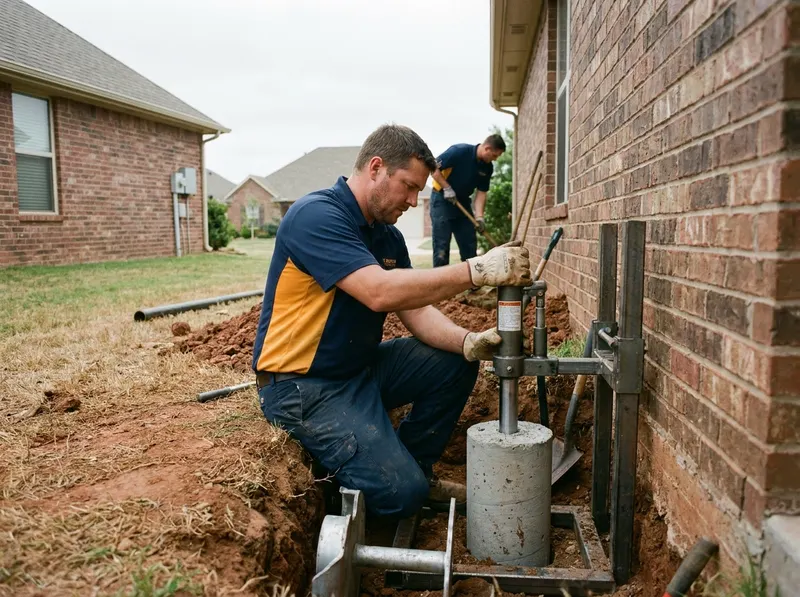
Pressed concrete piers suit Norman's slab-on-grade housing stock well because the installation process is largely non-invasive. A hydraulic ram positioned inside a shallow access pit pushes pre-cast cylinders downward in sequence, stacking pier on pier until the column meets soil that resists further movement, that resistance point, called refusal, is what gives the pier its long-term load capacity. No large crane, no open trench along the perimeter, and no concrete mixing on-site. Neighborhoods built on filled lots or cut-and-fill terrain, Shadowridge, Colony West, and parts of Timberlake, often show uneven refusal depths from pier to pier because fill thickness varies across a single foundation footprint. A technician who has driven piers in those areas can read that variability in real time and adjust the stack length accordingly rather than assuming a uniform depth.
The soil beneath much of Norman is the reason pressed concrete piers are a relevant option in the first place. The Grainola silty clay and Dennis clay loam that dominate Cleveland County's residential plats shrink during the dry Oklahoma summers, sometimes losing enough volume to drop a slab edge 1 to 3 inches over a single season, then swell back when fall rains arrive. Homes in Brookhaven, Westwood Park, and Brookfield Estates built in the 1970s and 1980s on shallow perimeter beams are particularly susceptible because those beams were designed to a moisture regime that no longer matches Norman's documented drying cycles. Pressed concrete piers bypass the active clay layer entirely by driving through it to the more stable soil or weathered shale below, typically between 10 and 25 feet depending on location within the county.
Decision fit matters here. Pressed concrete piers are a permanent stabilization tool, the right choice when settlement has progressed beyond seasonal fluctuation and a consistent load path to stable soil is needed. For a foundation that is moving seasonally but has not yet reached a structural threshold, a technician may recommend monitoring or drainage correction first, because driving piers into a foundation that still has seasonal recovery potential can overcorrect the elevation and create new problems. Homes near the Canadian River drainage corridor west of Riverwind Casino, for example, sometimes show settlement that is more moisture-management than structural, and honest triage means saying so. The goal of a site visit is to determine which situation applies before a pier count is proposed. Liftwell Foundation Repair technicians will tell a homeowner when piers are not the right next step, because a correctly scoped project is the only kind worth doing.
For homes in Oakwood, Greens at Westport, Whispering Heights, and University North Park, access conditions vary: mature landscaping, concrete flatwork, and utility lines all affect where access pits can be placed and how many piers a crew can install per day. A pre-job utility locate, standard practice before any excavation in Oklahoma, takes place before the first pit is opened. The Cleveland County Courthouse records and USGS soil survey data for Section Township Range coordinates in Norman inform depth estimates, but actual refusal depth is confirmed by the hydraulic pressure reading during driving, not by a desk calculation.
Every job gets a firm, written price after a free on-site visit.
Tell us about your pressed concrete pier installation job in Norman and we'll send a clear, written quote, usually the same day.
 Liftwell Foundation Repair