Norman sits on expansive Grainola-Renfrow clay soils that can shift 2, 4 inches vertically between a wet spring and a drought summer. That soil movement is the primary driver of the concrete cracks that appear in slabs…
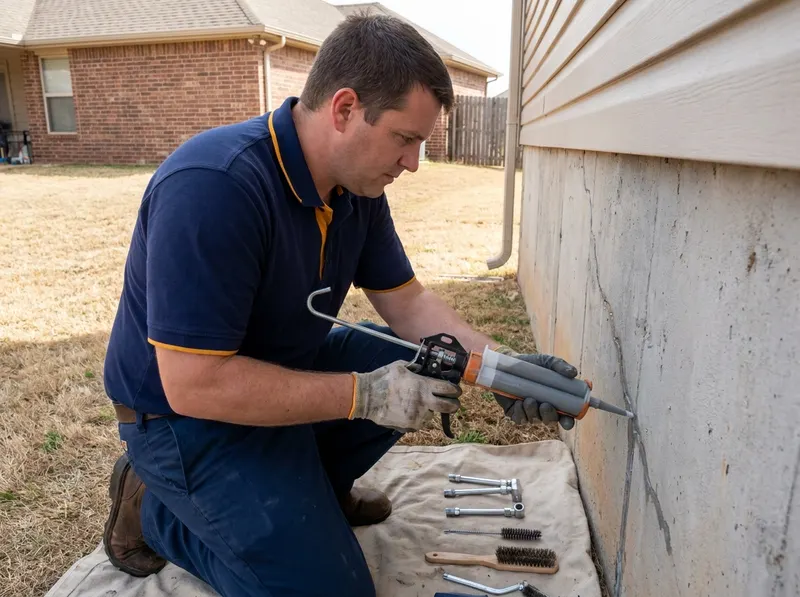
Norman sits on expansive Grainola-Renfrow clay soils that can shift 2, 4 inches vertically between a wet spring and a drought summer. That soil movement is the primary driver of the concrete cracks that appear in slabs and foundation walls across neighborhoods like Whispering Heights, Timberlake, and Brookfield Estates. A crack is not automatically a structural emergency, but it is a data point, its width, orientation, and location tell a trained eye whether the slab is still stable or whether deeper movement is underway. A hairline shrinkage crack under 1/16 inch wide that has not moved in two seasons is a sealing job. A stair-step crack in a block foundation wall in Oakwood that has widened 1/8 inch since last spring is a different conversation entirely.
The injection method depends on what the crack needs to do after it is filled. Polyurethane foam injection expands to fill voids and flex with minor future movement, making it the standard choice for non-structural cracks where stopping water infiltration is the primary goal, common in the older ranch slabs of Westwood Park and the split-levels near University North Park. Epoxy injection cures rigid and bonds at roughly 6,000 psi in tension, restoring near-original structural continuity across the crack plane, the right call when the crack runs through a load-bearing section of a poured-concrete wall or footing. Choosing the wrong material is a real mistake: epoxy in a crack that still moves will re-crack adjacent to the fill within one or two seasonal cycles; polyurethane in a structural crack leaves the wall carrying load across a flexible joint it was never designed to flex across. Liftwell Foundation Repair measures crack width at multiple points, checks for differential displacement across the crack face, and selects the material to match the actual condition.
The injection sequence follows five steps. 1. A technician cleans the crack surface and installs injection ports at 6, 12 inch intervals along the crack length. 2. A surface seal is applied between ports to contain injection pressure. 3. Resin is injected at the lowest port under low pressure, typically 40, 80 psi, until material appears at the next port up, confirming full penetration. 4. Each port is capped in sequence. 5. The surface seal is ground flush after cure. On a standard Norman slab crack, steps 1 through 4 take under two hours; epoxy requires a 24-hour cure before the surface grind. Homes in Colony West and Greens at Westport that have a crawl space or partial basement should expect the technician to inspect from both sides of the wall when accessible, a crack visible on the interior face often has a corresponding exterior path that must be addressed to stop water entry completely.
Concrete crack injection is the appropriate scope when the crack is isolated, the surrounding slab or wall is still level and plumb, and no active settlement is occurring beneath the footing. When a door in Shadowridge sticks because the slab has dropped 3/4 inch on one side, crack injection alone will not fix the door, the slab needs to be lifted first, then the crack sealed. Liftwell Foundation Repair assesses both conditions at the same visit and will tell a homeowner clearly if the crack is the whole problem or a symptom of something that needs a different primary repair. That distinction is the most important thing to understand before signing any crack repair proposal.
Every job gets a firm, written price after a free on-site visit.
Tell us about your concrete crack repair and injection job in Norman and we'll send a clear, written quote, usually the same day.
 Liftwell Foundation Repair