Cleveland County's expansive Garber-Wellington sandstone and overlying Vanoss loam and Port silt-loam soils shift measurably with Oklahoma's wet-dry cycles. In neighborhoods like Brookhaven and Colony West, where 1970s…
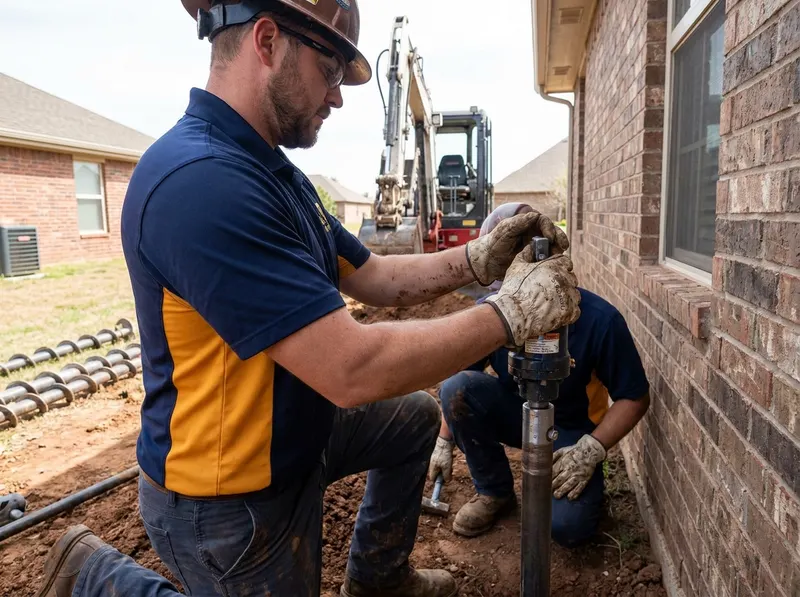
Cleveland County's expansive Garber-Wellington sandstone and overlying Vanoss loam and Port silt-loam soils shift measurably with Oklahoma's wet-dry cycles. In neighborhoods like Brookhaven and Colony West, where 1970s and 1980s slab-on-grade construction sits directly on fill placed over that reactive clay, seasonal movement of 1, 3 inches is common enough to be a documented regional pattern, not an anomaly. Helical piers address this by bypassing the unstable zone entirely. Each pier is torque-driven in 3- to 5-foot extension segments until the helix plates engage competent bearing strata, typically at 15, 30 feet below grade in most Norman locations. Installation torque is measured in real time; when torque correlates to the engineered capacity target, the pier is terminated and a steel bracket is grouted to the footing. The process is mechanical and measurable, not a judgment call.
Helical piers suit situations where access is limited or where the foundation needs both stabilization and the possibility of lift. In Shadowridge and Whispering Heights, where mature post-oak root systems and narrow side yards make open excavation difficult, helical equipment fits through a standard gate and operates within a 4-foot working width. That is a genuine site constraint, not a marketing point. Push piers, the common alternative, require hydraulic resistance from the structure itself and work best on heavier, more uniformly loaded footings. Helical piers develop capacity through soil mechanics rather than dead load, which makes them the standard choice for lighter structures, additions, and any section of foundation where the load per linear foot is lower. A technician from Liftwell Foundation Repair will identify which system fits the actual load conditions at a given corner before a scope is written.
Homes near University North Park, Timberlake, and Brookfield Estates frequently show the same diagnostic pattern: a crack that first appeared at a door corner, widened over two to three summers, then stabilized, only to reopen after the heavy rains that precede Lake Thunderbird's seasonal fluctuations. That pattern points to ongoing soil movement rather than a one-time settlement event. Helical piers installed to the engineered depth stop further downward movement at the pier locations. Whether partial lift is achievable depends on the age of the settlement, the condition of the slab, and how the load is distributed, a site visit is the only reliable way to answer that question for a specific home. Liftwell Foundation Repair does not quote lift outcomes before measuring actual conditions.
Every job gets a firm, written price after a free on-site visit.
Tell us about your helical pier installation job in Norman and we'll send a clear, written quote, usually the same day.
 Liftwell Foundation Repair