Pier-and-beam homes in Norman sit on a network of wood beams supported by concrete or wood piers set into Cleveland County's shrink-swell Garvin and Kirkland series soils. When those soils dry out through a long…
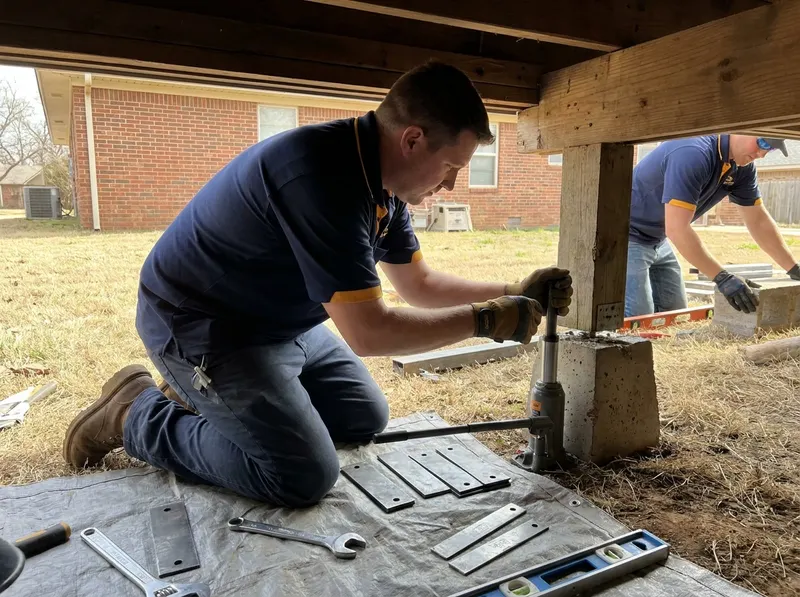
Pier-and-beam homes in Norman sit on a network of wood beams supported by concrete or wood piers set into Cleveland County's shrink-swell Garvin and Kirkland series soils. When those soils dry out through a long Oklahoma summer, the kind that runs 90-plus days above 90°F, the ground pulls away from piers, leaving them unsupported. When winter moisture returns, the soil re-expands unevenly. Over 10 to 20 years, that cycle causes piers to tilt, beams to sag, and floor joists to lose bearing. The symptom a homeowner notices first is usually a floor that feels soft or springy near the center of a room, or a door in an interior hallway that begins binding in late July and loosens again by November. Neighborhoods like Brookhaven, Timberlake, and Oakwood contain a concentration of pier-and-beam homes from the 1950s through the 1970s, and these patterns show up consistently in crawl spaces across those streets.
The repair sequence for a pier-and-beam system follows a logical order. First, a technician enters the crawl space, typically 18 to 36 inches of clearance, and measures floor elevations at 4-foot intervals using a digital level, mapping the low points. Second, the cause of each low point is identified: a settled pier, a rotted beam section, a missing shim, or a combination. Third, repairs are sequenced from the center of the structure outward, because lifting a perimeter point before correcting a center sag can split a beam. New concrete piers are typically poured at 12-inch diameter and allowed to cure 24 to 48 hours before bearing load. Sistered joists run parallel to the existing joist and are face-nailed at 6-inch intervals, effectively doubling the spanning capacity. Vapor barriers, 6-mil polyethylene sheeting covering the crawl-space floor, reduce ground moisture by roughly 70 to 80 percent according to building science standards, which directly slows future wood decay.
Pier-and-beam repair is the correct choice when floors are noticeably uneven, more than 1 inch of elevation change across a 10-foot span is a common threshold engineers cite, or when a crawl-space inspection reveals visible beam deflection or pier displacement. It differs from slab repair in that the structure is accessible from below without breaking concrete, which keeps repair costs lower for targeted problems. A homeowner in Whispering Heights or Colony West with a single soft spot near a bathroom may need only two new piers and a sistered joist. A Shadowridge home that has had chronic moisture issues for a decade may need full beam replacement across one bay plus a vapor barrier installation. Those are genuinely different scopes, and the on-site measurement determines which applies, a ballpark range cannot substitute for crawl-space data. University North Park and Brookfield Estates also contain pier-and-beam stock near the University of Oklahoma campus, where older construction predates modern moisture-management practices and crawl spaces frequently show early-stage beam softening that is far less expensive to address at the sistering stage than after full beam failure.
Every job gets a firm, written price after a free on-site visit.
Tell us about your pier-and-beam foundation repair job in Norman and we'll send a clear, written quote, usually the same day.
 Liftwell Foundation Repair