Cleveland County sits on Garber-Wellington sandstone overlaid with expansive Grainola-Renfrow shrink-swell clay soils. In neighborhoods like Brookhaven and Colony West, most homes built on slab-on-grade pads between…
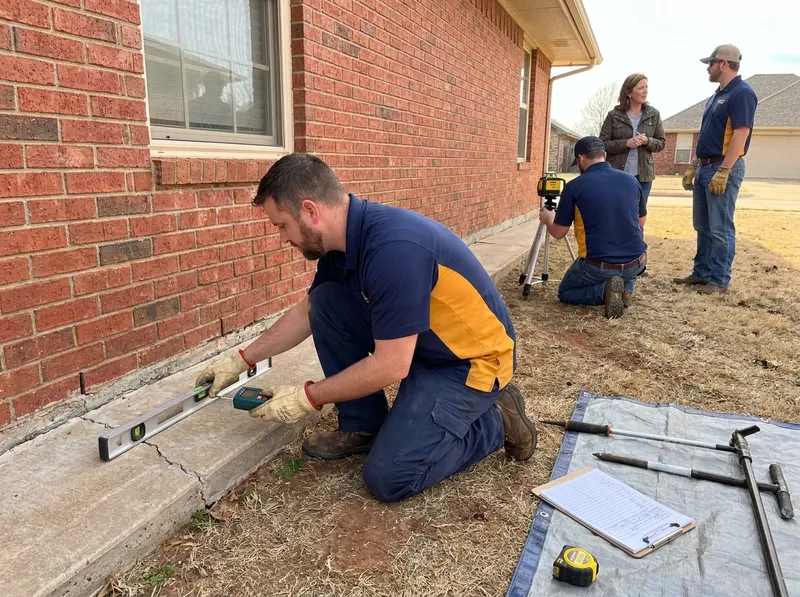
Cleveland County sits on Garber-Wellington sandstone overlaid with expansive Grainola-Renfrow shrink-swell clay soils. In neighborhoods like Brookhaven and Colony West, most homes built on slab-on-grade pads between the late 1970s and mid-1990s, those clays can lose 20, 30% of their volume during a dry Oklahoma summer and re-expand when fall rains return. That seasonal cycle, repeated over 20 or 30 years, is the most common driver of the diagonal corner cracks and sticky doors that prompt a Norman homeowner to finally call. The inspection process starts by measuring floor elevation at a grid of points across the slab, typically every 6 to 8 feet, using a digital level to quantify how much differential settlement has occurred and where the low zones are. A crack is then mapped by location, width (hairline under 1 mm vs. structural at 3 mm or wider), and direction, because a stair-step crack in a brick veneer tells a different story than a vertical crack at a window corner. Exterior drainage slope, downspout discharge distance, and any tree root proximity are documented, since those factors determine whether the movement is likely to continue or stabilize.
In Shadowridge and Timberlake, where lots often back up to drainage swales feeding into the Lake Thunderbird watershed, the inspection pays particular attention to soil saturation on the low side of the slab, a condition that softens the bearing layer and can accelerate settlement on one corner while the rest of the slab holds. In University North Park and Brookfield Estates, homes near the University of Oklahoma campus corridor sometimes show movement tied to aging municipal water and sewer lines, so the evaluation includes asking about any known utility work or plumbing leaks. Whispering Heights and Greens at Westport both contain homes built in the 1990s boom, when some subdivisions used engineered fill of variable compaction quality; the inspection notes any pattern consistent with fill settlement versus native-soil shrinkage, because the two conditions call for different repair approaches.
The written summary produced after an inspection names each observed condition, assigns a severity level (cosmetic, monitor, or repair-warranted), and describes the mechanism driving it in plain language, no jargon, no scare tactics. If repair is warranted, the report outlines the applicable method, pier installation, slab lifting, or drainage correction, and explains why that method fits the specific soil and movement pattern found on that property. If the evidence points to cosmetic cracking from normal concrete curing or seasonal movement within an acceptable range, the report says that clearly. A homeowner in Oakwood or Westwood Park who receives a clean or monitor-only result has gained a documented baseline: if symptoms worsen in two or three years, a second inspection can measure change against that first set of elevation readings, which is far more useful than starting from scratch. Scheduling an inspection after a second crack appears, or when a door that stuck last summer is still sticking in March, is the point at which the evaluation pays for itself in decision clarity.
Every job gets a firm, written price after a free on-site visit.
Tell us about your foundation settlement inspection and evaluation job in Norman and we'll send a clear, written quote, usually the same day.
 Liftwell Foundation Repair