Cleveland County sits on Verdigris and Port silt-clay loam soils that expand measurably when wet and contract when dry, a cycle that repeats every spring and late summer in Norman. A single inch of rain after a 90-day…
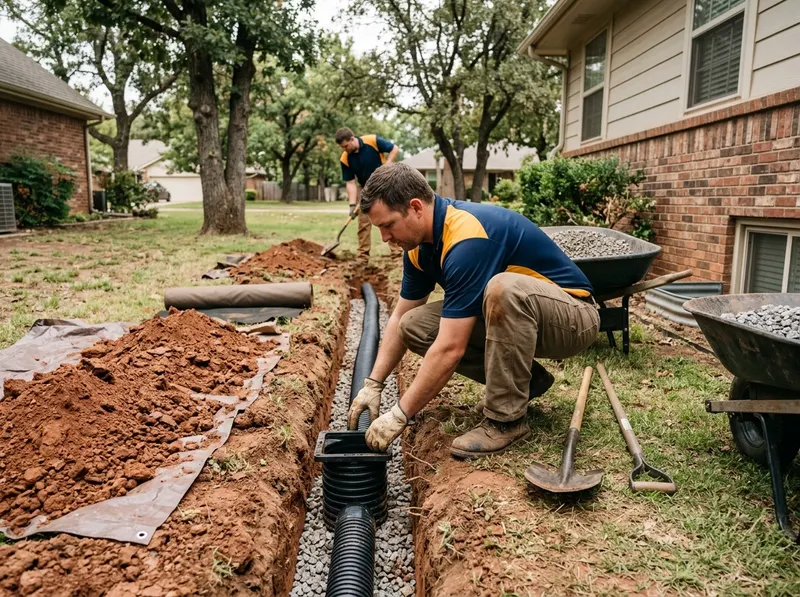
Cleveland County sits on Verdigris and Port silt-clay loam soils that expand measurably when wet and contract when dry, a cycle that repeats every spring and late summer in Norman. A single inch of rain after a 90-day dry spell can shift the moisture differential between the wet perimeter and the dry center of a slab by enough to crack interior drywall and bind door frames. Drainage correction interrupts that cycle at the source rather than treating the structural symptoms after the fact. In neighborhoods like Colony West and Greens at Westport, where lots were graded flat in the 1980s and original downspout extensions were never extended past the foundation wall, water routinely ponds within 2, 3 feet of the slab edge every spring. A properly sloped swale, ideally a 6-inch drop over 10 horizontal feet away from the house, carries that water to the street or a rear easement instead.
French drain systems are the right fit when surface grading alone cannot move water fast enough, typically on Timberlake and Whispering Heights lots where mature trees and established landscaping make re-grading impractical. A 4-inch perforated pipe bedded in washed gravel and wrapped in filter fabric can move several hundred gallons per hour to a daylight outlet or a street inlet. The trade-off is excavation width: a French drain trench is typically 12, 18 inches wide, which disrupts landscaping along its path. Surface swales are less invasive and cost less per linear foot, but they require enough open lawn to establish the slope. The decision between the two depends on available grade change, lot width, and proximity to neighboring properties, factors Liftwell Foundation Repair evaluates during the on-site visit before any work is proposed.
Soil moisture management extends beyond moving rainwater. In University North Park and Oakwood, where large post oak and red oak trees draw moisture from the soil within a 20, 30 foot radius of the trunk, the ground on the tree side of a slab can be 15, 20 percentage points drier than the opposite side by August. Soaker hose programs placed 18 inches from the foundation perimeter, run 30, 45 minutes every 2, 3 days during dry stretches, can reduce differential moisture to under 5 percentage points, a range Cleveland County clay tolerates without significant movement. Liftwell Foundation Repair identifies where supplemental moisture is needed based on crack pattern location and floor-level readings, not as a generic prescription. Downspout extensions are a small but measurable piece of the system: a 4-foot minimum extension moves the discharge point from directly against the footing to a zone where the soil can absorb water without saturating the foundation edge. Extensions of 6, 8 feet are common in Brookhaven and Westwood Park, where front yards slope back toward the house.
Every job gets a firm, written price after a free on-site visit.
Tell us about your drainage correction and soil moisture management job in Norman and we'll send a clear, written quote, usually the same day.
 Liftwell Foundation Repair