Norman sits on some of the most active shrink-swell clay in central Oklahoma. The Beaumont and Durant clay series that underlie neighborhoods from Oakwood to Greens at Westport can expand several inches vertically…
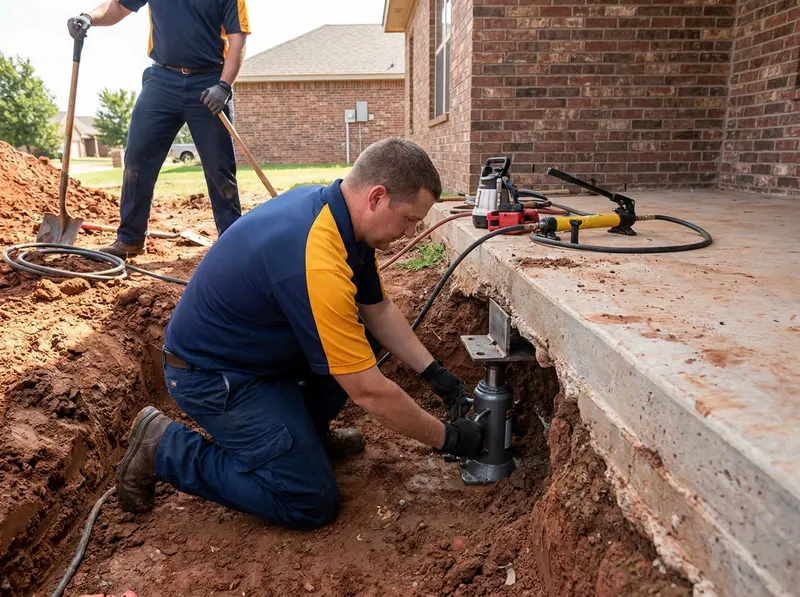
Norman sits on some of the most active shrink-swell clay in central Oklahoma. The Beaumont and Durant clay series that underlie neighborhoods from Oakwood to Greens at Westport can expand several inches vertically during a wet spring and contract just as dramatically by August. A concrete slab poured on that soil in 1984 has cycled through forty-plus seasons of that movement. The cumulative result shows up as diagonal cracks running from door corners, floors that tilt a quarter-inch or more across a ten-foot span, and doors along the south or west walls that bind every summer. None of those symptoms automatically mean catastrophic failure, but they do mean the slab has moved enough to warrant measurement, not guessing.
The two most common repair methods used on Norman slabs are steel push piers and helical piers. Push piers are hydraulically driven through the slab footing down to load-bearing strata, typically 20 to 35 feet below grade in the Cleveland County area, and then used to lift the settled section back toward its original elevation. Helical piers are screwed into the soil and work well where access is tighter or where the soil profile is less predictable, as it sometimes is near the drainage corridors east of Max Westheimer Airport and south toward Lake Thunderbird State Park. A third option, polyurethane void fill, addresses slabs that have lost soil contact underneath without significant structural cracking, common in Whispering Heights and University North Park where irrigation-heavy landscaping has eroded fine soils beneath interior slab sections. The right method depends on the depth to stable soil, the slab's post-tension status, and the pattern of movement, none of which can be determined from a photo or a phone call.
Homeowners in Brookhaven and Colony West often ask whether a visible crack means the whole perimeter needs piers. The honest answer is: usually not. A single settling corner near a downspout or a tree root zone may need two or three piers while the rest of the slab remains stable. Liftwell Foundation Repair's technicians measure floor elevations across the full slab using a digital level before recommending anything, because over-repairing a slab that only needs localized work costs the homeowner money and introduces unnecessary risk to adjacent sections. The goal of an inspection is an accurate map of where the slab has moved and where it has not, that map drives the repair scope, not a standard package.
Permit requirements for slab foundation repair in Norman fall under Cleveland County and City of Norman building codes. Structural pier work on a residential foundation generally requires a building permit; Liftwell Foundation Repair can advise on what the specific job requires during the inspection. Homeowners in areas near Griffin Memorial Hospital and Norman Regional Health System on 24th Avenue NW should also note that some older lots in those corridors carry utility easements that affect pier placement, another reason the site visit comes before any proposal.
Every job gets a firm, written price after a free on-site visit.
Tell us about your slab foundation repair job in Norman and we'll send a clear, written quote, usually the same day.
 Liftwell Foundation Repair